JULIÁN FUEYO

JULIÁN FUEYO
Serpiente de Turquesas
Recipient of the 2021 ASCAP Morton Gould Young Composer Award
Full Orchestra (pgs. 13-34)
Serpiente de Turquesas
FOR VIOLIN & ORCHESTRA
NOV. 2015
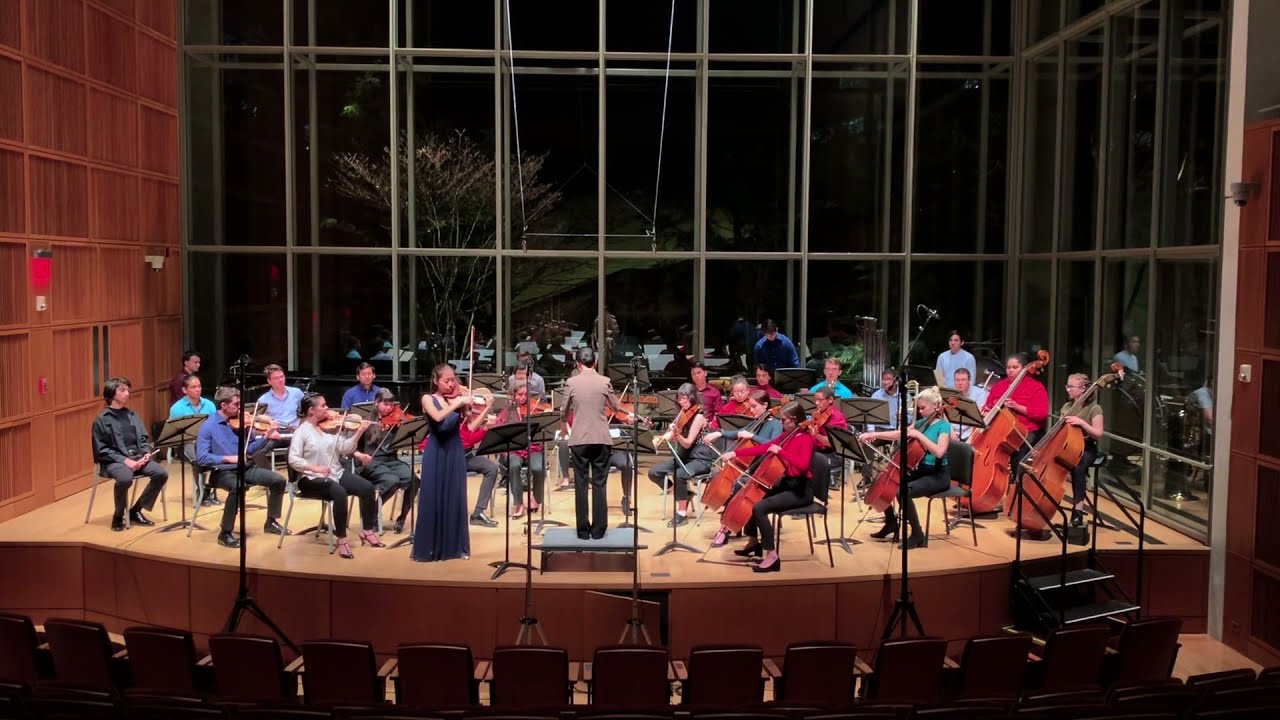
Violin solo: Shannon Lee (4th prize winner at the Queen Elizabeth Violin Competition)
Conductor: Sunny Xia
Concertmaster: Allie Switala. Violin: Julian Maddox, Maya Ito Johnson, Sofia Asasi, Mercedes Cheung, Daniel DiMarino, Manya Aronin. Viola: Tess Krope, Jerome McCoy, Alyssa Warcup, Marcus Stevenson. Cello: Sarah Miller, Jessamyn Fry, Ella Bondar. Bass: Hanna Wilson-Smith, Hollie Greenwood. Flute: Moisés López, Sebastian Brea, Daniel Lopez. Oboe: Eduardo Sepúlveda, Virginia Kao. Clarinet: Nicole Martin, Zikang Wang. Trumpet: Shane O’Brien, Joseph Keller. Trombone: Chris Wengert-Ramos, Peter Tapia IV. Bass trombone: Philip Williams. Tuba: Nickolas Withey. Percussion: Albert Mackey, Nathan Stenzel, Braden Vaughan, Samuel Conner.
About the piece:
Known as the “Serpiente de Turquesas” for its turquoise-blue rivers, Mexico's Huasteca region has inspired myth and artistic creation for millennia: from the Venus of Tamtoc to the surrealist worlds of Leonora Carrington and Edward James. A native of the region, Julián Fueyo transforms its fluid landscapes and pre-Hispanic conceptions of cyclical time into music, drawing on the mythological turquoise serpent as both a central symbol and a source of musical structure.
The turquoise serpent is a recurring symbol in pre-Hispanic art and religion, where turquoise itself was closely associated with water. Among its most striking representations is the turquoise-mosaic, double-headed serpent now housed at the British Museum. Its two opposing heads and carefully balanced form embody ideas of duality, symmetry, and cyclical movement: there is no singular beginning or end, but rather a continuous relationship between one direction and its reflection. In Serpiente de Turquesas, these visual and philosophical ideas become musical ones, translating the serpent’s symmetry and cyclical form into principles of musical structure.
The work earned Fueyo his second ASCAP Morton Gould Composer Award. Its fluid phrases unfold through retrogrades that follow as mirrored reflections of earlier musical material. The piece itself begins as it ends, while passages throughout its inner sections repeatedly circle back, mirror earlier gestures, and cascade into new musical spaces. By allowing the music to circle back upon itself, Serpiente de Turquesas connects the movement of the rivers with the serpent’s cyclical symbolism, creating a meditation on musical time, landscape, and natural memory.
Instrumentation: 2+picc.1.2 / 0.1.2+btbn.1 / 3perc / pn.cl / str
Piccolo
2 Flute (2nd doubling to Piccolo)
1 Oboe
2 Clarinets in Bb
1 Trumpets in C (Harmon Mute)
2 Tenor Trombones (Harmon mute)
Bass Trombone
Tuba
Percussion (3 players)
Percussion 1: Xylophone, Tambourine, Snare Drum, Glockenspiel
Percussion 2: Hi-hat, Chimes, China Suspended Cymbal, Vibraphone, Marimba
Percussion 3: Tam-Tam (Large), China Suspended Cymbal, Tubular Bells, Guiro
Piano (doubling Celesta)
Violin solo
Strings